
Welcome to this week’s edition!
We have been silent for the last few weeks, keeping with the pure Southern European fashion of the Villeggiatura, which The Guardian described as a hidden productivity booster. Now that we have recharged our batteries, we are ready for what looks like a pretty interesting final stretch of the year for work politics and work tech ⚡️
Today, inspired by a summer read (Tim Wu’s The Age of Extraction) I want to focus on a slightly broader angle around AI: ownership. And that takes us into land reform.
Enjoy!
A new land question
The question we want to address is: when AI becomes part of the infrastructure of work, who owns the terrain everyone else has to operate on?
It's easy to miss because AI is usually discussed as a tool, but it is really about building new systems. We ask whether workers are “using AI,” whether companies are “adopting AI,” whether students should be allowed to “use AI,” and whether knowledge workers will become more productive or be displaced (we covered all of this in The AI Adoption Illusion, and in the piece about Tokenmaxxing).
However, if AI becomes the operating layer of work - the place where we write, search, code, analyze, negotiate, sell, design, plan, remember, and coordinate - then access to AI will look less like access to a useful app and more like access to productive land. Compute, cloud distribution, model weights, training data, user memory, workflow context, and agent infrastructure become the terrain on which economic life happens.
And if that terrain is owned by a small number of firms, the future of work may become strangely feudal: everyone empowered, everyone accelerated, but most people working as tenants on someone else’s land.
The AI feudal state
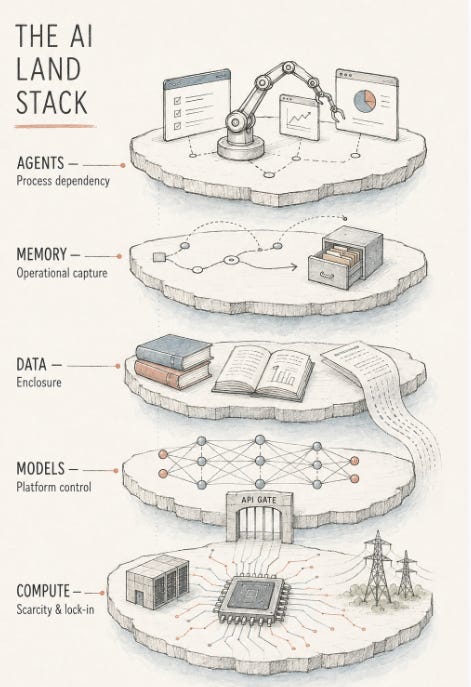
APIs are not medieval obligations, but the analogy is useful because both land and AI infrastructure are scarce productive inputs around which institutions, rents, and dependency form.
In an AI economy, the new “land” has several layers:
Compute: specialized chips, large clusters, energy access, datacenter capacity, and cloud contracts. We must start to think that frontier AI is is industrial infrastructure.
Models and weights: the model is a productive asset, not an artifact you license. If a startup, school, public agency, newsroom, or independent professional can run and adapt a capable model locally or through a competitive provider, they have some independence. If they can only call a closed model through a rented API, their “AI capability” is conditional on price, permission, terms of service, rate limits, and product strategy.
Data: the accumulated writing, images, code, scientific literature, forum posts, designs, customer records, business processes, and cultural archives that make models useful. The data commons that enabled the first wave of large-scale web training is already changing. We are already seeing a rapid increase in web-domain restrictions on AI training, especially among high-quality and frequently used sources, suggesting that the open web as a training commons is becoming more closed, negotiated, and legally contested.
Workflow memory: this may become the most important layer for the future of work. The value of an AI work system will not only be the base model. It will be the accumulated context of how a person or organization works: documents, decisions, preferences, recurring routines, task histories, customer relationships, approvals, exceptions, and demonstrated procedures. This is the institutional version of the AI second brain problem: whoever controls that memory controls switching costs. Worryingly, a growing set of tools is now focused on humans teaching AI by showing it how they work, both in blue- and white-collar contexts, only for those workers to risk being displaced later.
That is where the rentier logic enters. A worker may “have AI,” but only inside a closed subscription. A startup may “build with AI,” but only on a stack where cloud credits, model access, usage pricing, data-retention rules, and safety policies can change. A company may “automate workflows,” but only by depositing its operational knowledge into a vendor’s private system.
The new landlord does not need to own the worker. It only needs to own the ground the worker must stand on.
Call this what it is: context rent. Under feudalism a large share of the rent was never paid in coin. It was paid in labor and in kind, in days worked on the lord’s fields and improvements that simply stayed with the manor. The AI version is paid in demonstrated process: you produce it by working, it compounds, and it accrues on the other side of the ledger.
Capture is not new: what is new is which layer it reaches. Scientific management was an exercise in taking craft knowledge out of machinists' heads and printing it on instruction cards; moving know-how from the worker to the firm was the entire point. Cognitive work stayed outside that process for a century, but not because it was protected. It stayed outside because it was illegible. You cannot write an instruction card for judgment.
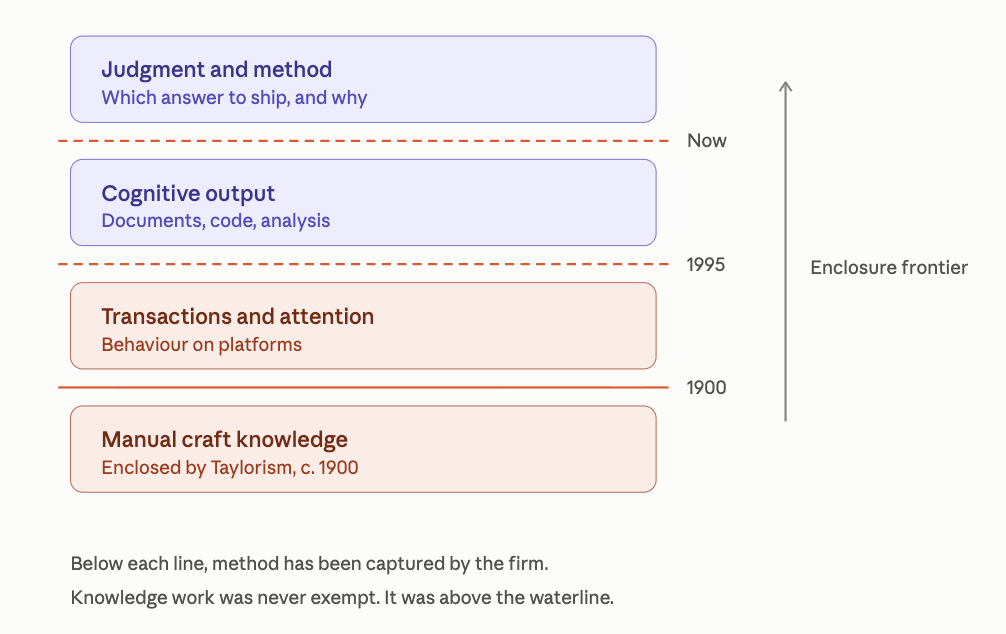
What large language models change is legibility: a demonstration is now machine-readable, so the frontier resumes climbing. Knowledge workers were never exempt from enclosure, they were just above the waterline.
From platforms to landlords
This is not entirely new. As argued also by Nick Srnicek’s account of platform capitalism, digital platforms are powerful because they position themselves as intermediaries that extract, control, and monetize data while benefiting from network effects.
AI intensifies both patterns: platforms became the terrain of markets. AI systems may go further: they can become the terrain of cognition and execution. The platform knew where the work happened. The AI work engine may increasingly know how the work happens.
This means that the key question is who captures the productivity, who controls the complementary assets, and whether workers gain new capabilities or simply face higher output expectations inside systems they do not own.
The more AI becomes embedded in daily work, the more painful it becomes to move, and this is the deeper version of the shift from selling access to selling work: when vendors sell outcomes, they also tend to accumulate the process knowledge that produces those outcomes.
Serfdom was abolished across Europe in waves, and the waves produced wildly different countries: the reforms that actually dismantled the feudal structure were the ones that moved title. Peasants received legal ownership of the land they already worked, or tenancy secure enough to behave like ownership, or a path to acquire it cheaply enough to matter. Seventeenth-century England did this, Scandinavia did it in the early 1800s and Japan, Korea and Taiwan did it after 1945. Those are also, not coincidentally, the economies that became broadly prosperous rather than narrowly prosperous.
Where emancipation arrived without endowment, it mostly rearranged the accounting: Russia freed its serfs in 1861 and then billed them for the land, in redemption installments that ran for decades. Legal status changed but the distribution of the productive asset did not. Economic historians studying the divergence between Western and Eastern Europe now argue that the timing of abolition across the continent is one of the better explanations for why development paths split as sharply as they did. Not whether. When.
So how would this translate in the context of the AI age?
One obvious answer that comes to mind is open source. Open models and local inference are essential to AI land reform. If capable models can run outside hyperscaler-controlled APIs, more people can experiment, adapt, audit, teach, and deploy AI on their own terms.
But this is not enough.
For an AI system to be meaningfully open, people need the freedoms to use, study, modify, and share the system, and they need enough information about the data, code, and training process to exercise those freedoms. A downloadable weight file is valuable, but it is not the whole farm. Without documentation, data transparency, tooling, compute access, evaluation methods, and deployment pathways, “open” can become a decorative label.
This echoes Elinor Ostrom’s work on commons governance. She showed that shared resources do not have to collapse into either state control or private enclosure; communities can govern commons through rules, monitoring, graduated sanctions, conflict-resolution mechanisms, and nested institutions. Translated: the AI commons will need similar institutional imagination, and we are far behind.
Closed corporate models and naive openness are not the only options. There can be governed data commons, public compute pools, research access regimes, cooperative licensing, model transparency standards, and sectoral institutions that distribute capability without pretending that all resources are free and frictionless.
AI land reform is a program, not a policy: broadening ownership, access, portability, and bargaining power across the AI stack.
What AI land reform could mean
A serious AI land reform agenda would have at least six parts:
1. Public and civic compute
If compute is a productive input, public institutions need access to it. Universities, schools, public-interest researchers, libraries, municipalities, independent labs, and small firms cannot rely solely on the leftover capacity or strategic generosity of hyperscalers.
The U.S. National AI Research Resource pilot is one precedent: it aims to provide researchers and educators with access to AI resources, including compute, data, models, software, and training. Public-interest AI requires infrastructure - without it, “responsible AI” becomes something under-resourced actors are asked to practice on infrastructure they do not control.
2. Genuinely open models and local inference
Small and medium models that run locally or on commodity infrastructure are economically and politically important. They lower the minimum viable scale of AI ownership and allow organizations to keep sensitive workflows closer to home. They create fallback options when platform terms change and also make AI literacy more concrete: users can inspect, modify, benchmark, and deploy systems instead of only consuming a remote service.
Local inference will not replace frontier clouds for every task. Land reform meant secure access to productive resources, not the best land in the capital, and it meant people need enough secure access to productive resources to avoid permanent dependency.
3. Data provenance, consent, and bargaining power
Creators and institutions need stronger ways to express consent, preserve provenance, and bargain collectively. This does not require treating every piece of data as a tiny parcel of private property; that path can become unworkable. But it does require moving beyond a one-time scrape of culture followed by private enclosure of the resulting capability.
Data trusts, collective licensing, provenance standards, and machine-readable usage preferences are imperfect but necessary experiments. The Data Provenance Initiative is useful here because it treats training data as measurable infrastructure rather than invisible background material.
4. Interoperability and portable memory
The next lock-in battle will be memory: if your agent knows your clients, calendar, writing style, codebase, research archive, recurring workflows, and approval rules, then exporting PDFs is not enough. You need portable context, portable workflows, portable embeddings or retrieval indexes, and human-readable procedures.
This is where the future of work meets the design of personal and organizational operating systems. A worker should be able to teach an AI system how they work without donating that skill permanently to a platform. The demonstrated workflow should become a readable, editable, exportable artifact: a playbook, skill, script, or protocol that can move across providers. That connects directly to GPTs and Business Process Industrialization and Building Effective “Agents”: the more process becomes software, the more important it becomes to know who owns the process.
5. Switching rights and anti-rentier competition policy
Competition policy needs to treat cloud, AI models, data access, and distribution as connected markets. If a cloud provider controls compute, model hosting, enterprise software distribution, and AI assistants, then “choice” at one layer may be undermined by dependency at another. Regulators are already circling this stack, but the future-of-work implications deserve more attention: lock-in shapes who can build, learn and bargain.
6. AI literacy as economic citizenship
Finally, land reform is not only about assets, but about capacity. Broad AI ownership requires broad AI competence: evaluating outputs, designing workflows, supervising agents, understanding data rights, protecting privacy, and knowing when to keep work local.
The worker of the AI era is increasingly a teacher of machines: demonstrating tasks, correcting workflows, setting boundaries, and deciding what should be automated. If those taught workflows remain portable and legible, workers gain leverage. If they disappear into closed systems, workers train their landlords.
TLDR; The real divide (or dividend?)
The public conversation often frames AI inequality as a skills gap: some people will learn to use AI and others will fall behind. That is true, but incomplete.
The deeper divide may be between people and institutions that own their AI capability and those that merely rent intelligence by the token.
Ownership here means durable rights and practical capacity, not every chip and dataset. It means having durable rights and practical capacity: the ability to run useful models, move workflows, inspect systems, bargain over data, access public compute, and keep operational memory from becoming a hostage asset.
Without that, the AI future of work could become a beautifully designed tenancy. Workers get copilots. Companies get dashboards. Startups get APIs. Schools get chatbots. Governments get pilots. Everyone gets a little magic. But the infrastructure, rents, and memory accumulate elsewhere.
So, what about the AI Dividends?
Over the past year the AI dividend has moved from think-tank paper to live legislative proposal. Alex Bores (a NY lawmaker/congressional candidate) has proposed a direct payment programme funded by a tax on AI use, equity stakes in leading AI companies, and changes to how labour and capital are taxed, triggered when AI measurably displaces American workers. Bernie Sanders’ American AI Sovereign Wealth Fund Act would go further and compel a transfer of equity. OpenAI’s April 2026 policy proposal sketches a Public Wealth Fund seeded by donated shares, whose returns could flow directly to citizens. Senior administration officials have discussed voluntary equity stakes with the major labs. In South Korea, a senior official proposed that citizens share in the semiconductor windfall, which promptly spooked investors. Amodei, Hassabis, Altman and Musk have all floated some version of a basic income funded by taxes on AI firms too.
The reference model everyone reaches for is the Alaska Permanent Fund. The reference model nobody mentions is older and closer to the point: in 1797 Thomas Paine argued in Agrarian Justice that because the earth was originally common property, every person dispossessed by the enclosure of land was owed compensation, funded by a charge on landholders. Paine proposed a payment because he had concluded the land itself was not coming back.
That is the shape of the AI dividend. It is a claim on the rent, not a claim on the asset. It accepts the ownership structure and negotiates the distribution of its proceeds.
Which is not nothing, of course. A dividend is redistribution, and redistribution matters, but it is emancipation logic, not endowment logic, and it carries the failure mode of every settlement built that way. Rent-sharing is revocable, it depends on the continued goodwill or continued regulation of the party holding the asset, and it does nothing about the thing this essay is actually about: whether a worker can leave with what they built. No dividend restores your workflow memory. No sovereign wealth fund makes your agent portable. You can be paid a share of the harvest and still be a tenant.
The serious version of the argument is that a dividend and a reform are complements rather than alternatives, and that is probably right. But notice which one is currently being negotiated in public, with named bills and White House meetings, and which one is not. The distribution question has a lobby. The ownership question does not.
AI land reform could be the alternative: a future where the means of work are not only more intelligent, but more widely held.
Great piece Matteo. The AI land stack is a very useful framework.
Your comparison between AI infrastructure and land ownership gets to the heart of the problem: who owns the productive assets, and who benefits as they become more valuable?
I believe there's another dimension to this question that deserves attention: consumer ownership.
Under today's transaction rules, consumers pay, businesses deliver, and the transaction is considered complete. Yet every genuine purchase also contributes to the long-term value of the business, while consumers generally receive no corresponding ownership rights.
What if we changed that?
If genuine consumption could generate long-term ownership rights, ordinary people would gain a way to accumulate productive assets through their everyday economic activity, even without substantial initial capital.
As businesses grow, individuals could accumulate wealth and gain income and purchasing power beyond wages. Over time, this could reduce their dependence on selling labor to survive, giving them greater economic independence and the freedom to choose whether, when, and how to work.
At the same time, broader ownership could strengthen consumer demand, support business growth, and create a self-reinforcing cycle in which personal prosperity and economic expansion reinforce each other.
This could help address AI-driven job displacement, concentrated ownership, insufficient consumer demand, and the widening gap between productivity and personal wealth.
I've written an article proposing a complete framework that connects consumer ownership, individual wealth accumulation, economic freedom, and sustainable growth, including how these rights could be recorded, verified, and assigned.
I'd genuinely welcome your thoughts, particularly on how this could complement broader efforts to democratize ownership of AI-era productive assets.
https://thinkwithcy.substack.com/p/from-fear-of-ai-driven-job-loss-to?r=9aek4h