
Lower-Value Human Capital
Why language is more important than ever at work


The CEO of a bank recently announced plans to eliminate 7,800 jobs by 2028.
In his comments about how AI would allow the replacement of back-office jobs, he said,
“It’s not cost cutting. It’s replacing, in some cases, lower-value human capital with the financial capital and investment capital we’re putting in.”
This is, sadly, a fairly normal announcement these days, but he used fairly pernicious language about his workers.
Bill Winters is the CEO of Standard Chartered which employs about 82,000 people. There was a bit of a backlash in the media about his description of workers as ‘lower-value human-capital’.
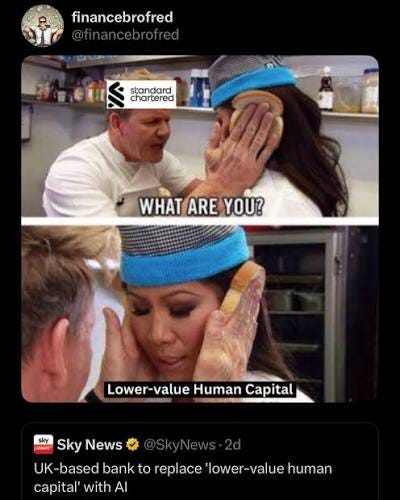
Whether there will be long term damage from these comments remains to be seen. The share price is up about 12% since the announcement.
The bank will still have around 74,000 employees after the cuts. I wonder how some of the remaining medium and high-value human capital feel about the phrase.
But this article is not really about one CEO or one bank.
Maybe Bill’s real crime was articulating a little too clearly how the top brass talk about the AI shakeout.
Because ‘lower-value human capital’ did not appear from nowhere. It comes from a long line of 20th-century managerial thinking, layered over with 21st-century consulting, finance and marketing language.
We should not be surprised by dehumanising language at work. The surprise is that we still pretend it is accidental.
So here are three phrases I would put straight into Corporate Room 101.
Corporate Room 101 #1 - Human Resources
The phrase ‘Human Resources’ has its roots in the dismal science of economics.
It carries an accounting worldview: people are viewed as productive resources to be developed, allocated and managed in the service of organisational output.
In this mindset, the organisation is a system of inputs: land, labour, capital, materials, equipment, money - and then, eventually, ‘human resources’.
This matters because ‘resource’ is not an innocent word.
A resource is something used to achieve an end. So even when the intent was progressive - the language still placed people inside an instrumental frame.
Referring to your workforce as a resource reduces people to the role of a utility - like a machine, capital, or a donkey.
Corporate Room 101 #2 - Talent Management
The phrase ‘Talent management’ is more recent. It was popularised by McKinsey’s late-1990s ‘War for Talent’ work.
Don’t start me on military metaphors at work.
Of course, organisations have always had workforce planning, succession planning, employee development and career management. But Talent Management was born in consulting and popularised by HR vendors because it made ordinary workforce processes sound strategic, scarce and expensive.
Why call it workforce management, with performance and pay plotted on boring distribution curves, when you can pretend everyone is ‘talent’?
If an organisation has 10,000 workers, they are not all ‘talented’ in the same way.
Some are brilliant. Some are struggling. Most sit somewhere in the middle, doing useful work under imperfect conditions inside systems they did not design.
Talent Management was vendor lipstick on a 20th-century pig: a shinier label for the old machinery of ranking, segmenting, acquiring, retaining, deploying and exiting people.
Corporate Room 101 #3 - Human Capital
My last ‘proper job’ was at Deloitte in London 2006 as a management consultant in the Human Capital practice. I could not mention Human Capital to clients, let alone family and friends, preferring the softer, sub-division of ‘People and Change’.
Whether lower value or higher value, what a horrible way to describe a person.
Human Capital is more directly rooted in economics and investment logic. It is associated with economists such as Theodore Schultz and Gary Becker, where education, skill and knowledge are treated as forms of capital investment.
So if you want to make the ‘financial people’ point, human capital is the cleaner target than ‘human resources’.
If ‘Human Resources’ says people are resources to be utilised.
Then ‘Human Capital’ says people are assets to be bought, upgraded, sweated and sold.
Watch your language folks.
Moving on Up the Value Chain
The way we talk about work has been shaped by economic and corporate models from the 20th century, with an added layer of American consulting pizzazz.
Now AI is forcing another round of automation, restructuring and repricing.
Automation in work has been going on since industrialisation and the digital revolution of the 1970s. But this one is hitting the office, the laptop class, the back office, the analyst, the junior worker, the support function and the knowledge worker.
Those who lead the AI shakeout need to reflect on the language they use for the people they will need to manage the machines.
This poses a few questions :-
What workplace phrases do you most dislike?
In an AI economy, who gets to decide which humans are ‘lower-value’?
What does your language reveal about how you see work?
Final thought - using language that motivates and engages rather than disenfranchising might just be a differentiator in competitive labour markets.
If leaders talk about people as disposable units of capital, they should not be surprised when people treat the organisation as disposable too.
Moving on up the value chain,
Andy
The language matters, but the number underneath it is the part that doesn't get discussed enough. 7,800 people cut, 74,000 stay, and share price up 12%. That gap is the actual signal. The market didn't reward the phrase, it rewarded the headcount reduction, which means every other CEO watching learned that harsh language costs a news cycle but soft language costs nothing at all. The euphemism isn't protecting the workers. It's protecting the leaders who'd rather not notice they made the same call.
Wow, that Standard Chartered quote is brutal.
My most hated word? “Job losses”
…like they’ve misplaced them somehow down the back of the sofa🙄