


This edition of Work3 is sponsored by Glean's launch of Independent Agents.

If the job is being unbundled, so is the org chart. Glean's new independent agents are designed as AI coworkers, with their own identity, memory, and accountability, built to take on the kind of work that used to fall to the newest person in the room. Worth a read alongside this essay's question about who trains the next generation when AI gets there first.
Will AI take our jobs?
It is an emotionally charged question.
But it is also too narrow.
The deeper question is this:
How do we build a fair society that does not depend so heavily on the job?
A job is not just a contract for paid labour. It is the container through which modern societies distribute income, purpose, status, training, identity, time, benefits, pensions, security, and belonging.
That is why the AI jobs debate cuts so deep.
We don’t just fear unemployment, we are afraid that the whole social machinery built around employment may be lost too.
So what can we do?
Some will wait for the job apocalypse. Others will use AI to eat market share.
But the harder task is to ask what happens when work is deconstructed - and how we rebuild the institutions that once made employment feel secure, meaningful and fair.
The Job Was Never Just a Job
For much of human history, people worked without having what we would now recognise as a ‘job’.
They farmed, traded, cared, cooked, repaired, hunted, gathered, built, taught, healed, raised children, maintained households and contributed to communities.
Remote work is not new. For example in Britain from the 1600s to the mid-19th century, workers made dresses, shoes, and matchboxes in their kitchens or bedrooms.
With mechanisation, from the spinning jenny to the power loom, work that had once been scattered across homes and communities was increasingly pulled into factories.
And the modern job was created.
We created the 12-hour day, fought for the 10-hour day, normalised the five-day week and invented the weekend.
The job was never a natural law. It was designed, contested and redesigned.
That is why today’s debate should not stop at shorter weeks, flexible hours or better benefits. Those may matter, but the deeper question is what happens when the job itself can no longer carry all the social functions we attached to it.
For some, the job gave meaning, identity, status, structure and purpose.
For most, it put food on the plate.
For society, it became a mechanism for redistribution, education and security.
But the job, and many of the institutions we built around it, are beginning to fracture.
No More Absolute Beginners
The danger is not only a world without jobs. It is a world without absolute beginners.
The routes into work are becoming narrower, harder and more fragile.
Graduates in the US have been booing the mention of AI at commencement or graduation ceremonies. Of course this talented generation are using AI and the extraordinary tools in their hands.
This protest is not about technology but the social contract around work.
Earlier generations could plausibly believe that education, hard work and entry-level employment would lead to career progression, home ownership and financial security.
For many younger people, that bargain already looks broken. This is why the death of entry-level jobs matters.
The UK gives us a glimpse of what happens when the routes in start to fail. Alan Milburn’s interim report warns that more than one million 16–24-year-olds are not in education, employment or training - around one in eight young people. Nearly six in ten economically inactive young people have never had a job. Yet 84% of these young people surveyed say they want work, education or training.
So this is not a simple story of young people opting out. It is a warning that the labour market is no longer reliably letting them in.
Young people do not only need skills.
They need routes in.
Join the Work3 Brains Trust
If the job can no longer carry the full weight of income, learning, identity, security and progression, what should take its place?
This is the question we will explore in next week’s Work3 Brains Trust for paid Futurist subscribers on 22nd July 2026 - 5 pm UK / 12 pm ET
We will discuss:
whether entry-level jobs are really disappearing, or being redesigned
what young people need if the first rung of the career ladder is weakening
how employers should rebuild learning when AI absorbs junior tasks
whether AI dividends and new forms of ownership are realistic
what a post-job social contract might look like in practice
The Brains Trust is open to paid Futurist subscribers.
For paid Futurist subscribers: continue reading for why the post-job world is already here, what comes after the job, and five functions we need to rebuild - including the AI dividend.
The Post-Job World Is Already Here
The post-job world is not a prediction. It is a distribution problem.
For some, it already looks like freedom: portfolio careers, fractional roles, creative independence, self-employment, AI-enabled micro-enterprises and the ability to work beyond one employer, one office or one job description.
For others, it looks like instability: insecure hours, weak benefits, algorithmic management, low bargaining power and no obvious path forward.
This is why ‘more good jobs’ is an appealing answer, but not a complete one.
Three uncomfortable realities complicate the story.
First, most work in the world already happens outside the secure formal job. Of the roughly 3.4 billion people in the global workforce, around 2 billion work in the informal economy, often without contracts, benefits or meaningful legal protection. A world beyond formal jobs is not some distant future. It is already the daily reality for much of humanity.
Second, flexible and independent work is no longer marginal. The global gig economy was estimated at $557bn in 2024 and is projected to triple by 2032. Around 14.5% of EU workers are self-employed. China estimates it has around 200 million “flexible workers”. Some people are pushed into this world by necessity. Others choose it because they do not want the obligatory boss, fixed schedule or single-employer career. Either way, work is increasingly leaking out of the traditional job container.
Third, even having a job no longer guarantees security. In the UK, almost seven in ten working-age adults in poverty live in a household where at least one adult is in work. In the US, more than 40% of people below the poverty line live in households with at least one worker. The old promise was that employment would be the route out of insecurity. For too many people, that promise no longer holds.
So the old distinction between “employed” and “unemployed” is becoming less useful.
The real divide may be between those who have access to income, learning, assets, networks and agency - and those who do not.
The post-job world is not necessarily a leisure society, as Arthur C. Clarke imagined. It may be a society with more work, but less of it contained inside the traditional job.
It is what happens when the job stops being the main way people get income, learning, identity, security and belonging - and what we need to build next.
Five Functions to Rebuild
What comes after the job is not a world without work.
It is a world where the old job bundle has to be rebuilt.
For the past century, the job has been asked to do far more than organise paid labour. It has carried income, security, learning, status, belonging and a route into the future.
If that bundle is now coming apart, we should stop pretending the answer is simply “more jobs” or “better skills”.
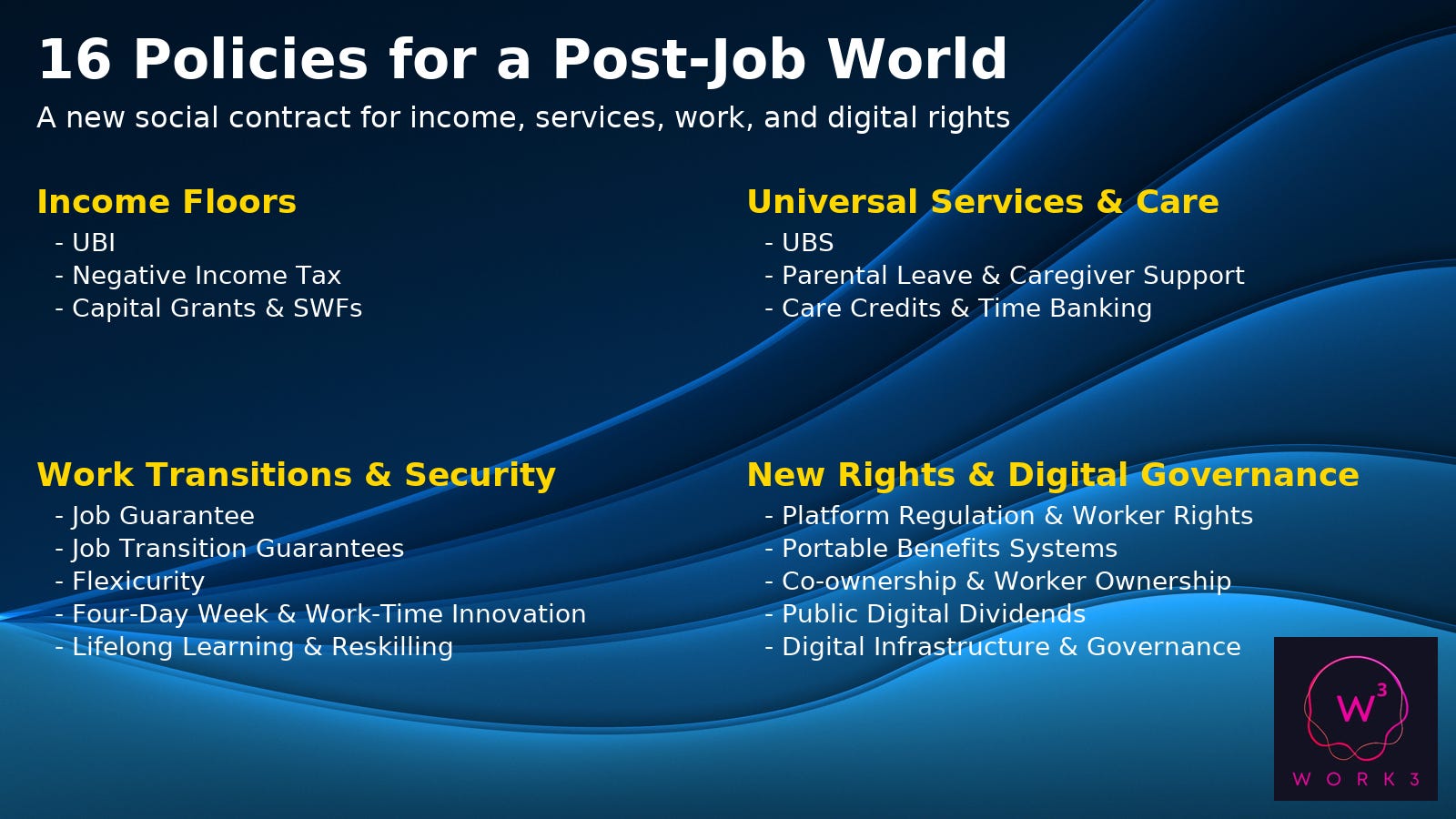
In previous Work3 essays, we explored 16 policies for a post-job world. But underneath the policy debate are five human needs that any serious post-job social contract has to answer. Five stand out.
1. Financial Security after the job
If work becomes more fragmented, income becomes more volatile.
That does not mean everyone needs a universal basic income tomorrow. But it does mean societies need better ways to smooth income shocks, support transitions and prevent temporary disruption becoming permanent exclusion.
The question is whether people can take risks, retrain, care, move, build and adapt without one lost job turning into a lost life.
The most important point is this: financial security has already been partly dismantled from employment.
The old job used to bundle income with pensions, benefits, sick pay, training and progression. As those links weaken, security needs to become more portable.
The question is not whether people should work.
The question is whether they can take risks, retrain, care, move, build and adapt without one lost job turning into a lost life.
Example: Japan’s Fureai Kippu (“Caring Relationship Tickets”) allows people to earn credits by caring for elders, redeemable later in life.
2. Learning after the job
If AI weakens the entry-level ladder, learning cannot remain a one-off event at the start of life.
We will need more apprenticeships, not fewer. More work trials. More project-based learning. More mid-career transitions. More employer investment in beginners. More ways to prove capability outside degrees and job titles.
AI tutors may help. Digital credentials may help. Skills accounts may help.
But the deeper challenge is institutional.
Who is responsible for developing people when employers want ready-made talent, schools cannot keep up with labour-market change and AI absorbs the low-level work that used to train beginners?
Example: Singapore’s SkillsFuture gives adults state-backed credits for approved training.
3. Status after the job
Jobs provide status.
“What do you do?” remains one of the most common social questions. We still use job titles as shortcuts for competence, class, ambition, identity and social worth.
But in a post-job world, many people will not have one neat answer.
They may be building, caring, learning, consulting, freelancing, investing, volunteering, creating or experimenting. They may be between projects. They may be doing economically useful work that does not fit inside a job title.
So we will need new ways to recognise contribution.
Portfolios. Credentials. Reputation systems. Peer networks. Proof of work. Community roles. Public contribution. Ownership stakes. Learning records.
This matters because people do not only need money.
They need dignity.
4. Belonging after the job
The workplace has often been a flawed community.
It can be political, exhausting, hierarchical and exclusionary.
But it has also been one of the main places where people meet others, build friendships, learn norms, find mentors and feel part of something bigger than themselves.
As work becomes more remote, fragmented and AI-mediated, belonging will not happen automatically.
Where do people find community outside the traditional workplace?
Professional guilds may return. Local work hubs may matter. Online communities may become more serious. Alumni networks may become lifelong career communities. Co-operatives, creator networks and member-led institutions may take on more importance.
The future of work is also the future of belonging.
5. Ownership after the job
This may become the biggest question of all.
If AI creates enormous wealth, where will that wealth go?
Without new models, most of the upside will flow to the shareholders of technology companies.
In the US, politicians have floated versions of citizen dividends from AI businesses.
This might be easier in the US or China, where AI champions are domestically based. But what about countries without AI market leaders?
This kind of redistribution is not so far from reality. Many workers are already capitalists, with shares in their retirement accounts and pensions in Nvidia, Alphabet, Apple etc
If income once paid to workers increasingly appears as profits in AI companies, chipmakers, data centres, cloud providers or infrastructure owners, then societies will face a distribution problem as much as an employment problem.
Other ideas include tax AI profits, levies on data centres, higher taxes on capital and lower taxes on labour, sovereign wealth funds.
There are problems with all of these ideas.
Governments may pick the wrong companies. Tax systems are slow. Tech firms are skilled at shifting profits across borders. Public ownership can create political conflicts. Data-centre taxes may be passed on. And countries without large AI champions cannot simply seize shares in foreign firms.
But the ownership question will not go away.
If AI makes a small number of firms and asset owners vastly richer while many workers face weaker bargaining power, unstable income or fewer routes into good work, politics will become ugly fast.
The post-job world cannot only be about safety nets.
It also has to be about who owns the machines, platforms, data and institutions through which future work flows.
Our Most Important Work
The job is not disappearing overnight. Many jobs will survive, some will become more valuable, and new ones will be created.
But the job may no longer be strong enough to carry the full weight of income, learning, identity, security, belonging and social mobility.
That leaves us with the most important work of all: rebuilding the institutions that help people build lives.
The real question is not whether AI takes all the jobs, whether we should slow down technology, or whether everyone ends up idle.
It is what jobs used to do for society - and what happens when they stop doing it.
What comes after the job?
Not one policy, but new institutions, new ownership models and new ways to organise useful human contribution.
Work will not disappear - but the old job can no longer carry the society we built around it.
Post-job since 2006,
This is an important distinction. The question isn't only whether AI will replace jobs, but how it will change the way people create value and build careers. The shift could be much bigger than automation alone.
The learning section names the right gap but skips who closes it before any institution catches up. When AI takes the routine drafting and the basic research, the training reps built into that work don't disappear, they get reassigned to whoever is already skilled enough to explain the task instead of just doing it. That's unpaid mentorship wearing a generosity costume, and it never gets counted as labour.